



Scents of Saint-Helena island
Modest island in the middle of Atlantic Ocean, 2000 kilometers from Africa and 3000 kilometers from Brazil, the British Saint Helena does not offer the tropical climate that one would expect. Probably a chance for the Mameluck Ali (1788 - 1856) who found the necessary ingredients for the empirical reconstitution of the Emperor's Eau de Cologne.
England, a precious help in the import of the necessary ingredients for Cologne.
Discovered in the 16th century by a Portuguese navigator, the island surprises by its temperate climate, its fresh water and its prodigality. Famous sailors, the British seized St. Helena in the 17th century and have the favourable idea to introduce lemon trees, essential ingredient in the Eau de Cologne. Then it is the spirited botanist William John Burchell (1781 – 1863) who settles on the island to study the flora from 1805 to 1810. Five years during which our scientist introduced plants from around the world, revealing a perfect unconsciousness as to risks that his experiments would put on the endemic species. Ironically, the subjects of the perfidious Albion prepared the ground for the future conception of Eau de Cologne.

Then it is François Antommarchi (1780 or 1789 – 1838), doctor by profession, who was dispatched on the island in 1819 by Maria Letizia Bonaparte (1750 – 1836), the Emperor’s mother. During this stay, he wrote a “Sketch of the flora of St. Helena” published in 1825 and whose spiteful English say that it is a “work of mediocre quality” (William Botting Hemsley, botanist) but that does not matter, it is enough for us to foresee the ingredients to which the Mamelouk Ali had access to reproduce the Emperor’s dear Cologne.
[thrive_leads id=’74591′]
The Mediterranean flora of Saint Helena.
Cologne is composed of citrus, bergamot, rosemary, orange blossom, lavender and cinnamon. Each recipe introduces variants by adding or removing ingredients. The Mameluck Ali was not unaware of this when he undertook to reproduce the fragrance. Thus, the work of Antommarchi allows us to apprehend the flora to which the budding perfumer had access. Melissa, false marjoram (but as well odoriferous), thyme, rosemary, wormwood, angelica, nutmeg, lemon peel and wallflower (which flowers have a scent resembling that of clove) grew freely and at hand. As for the aromatics often used in the preparation of the Cologne (cinnamon and cardamom in particular), it is very conceivable that the supply of the island by the ships of the British East India Company provided the lack of these ingredients.
If Napoleon quickly challenged the medical skills of Antommarchi, he certainly does not question his taste for botany that, perhaps, participated in the improvement of the Mameluck recipe.
Cologne: Between Pharmacy and Perfumery
Elaborated from the medieval recipe of a Florentine convent, Cologne is first presented by its creator as a remedy rather than a cosmetic fragrance. A perfectly natural consideration in the 18th and 19th century that echoes in our contemporary use of essential oils.
Cologne: the Panacea of the 19th Century
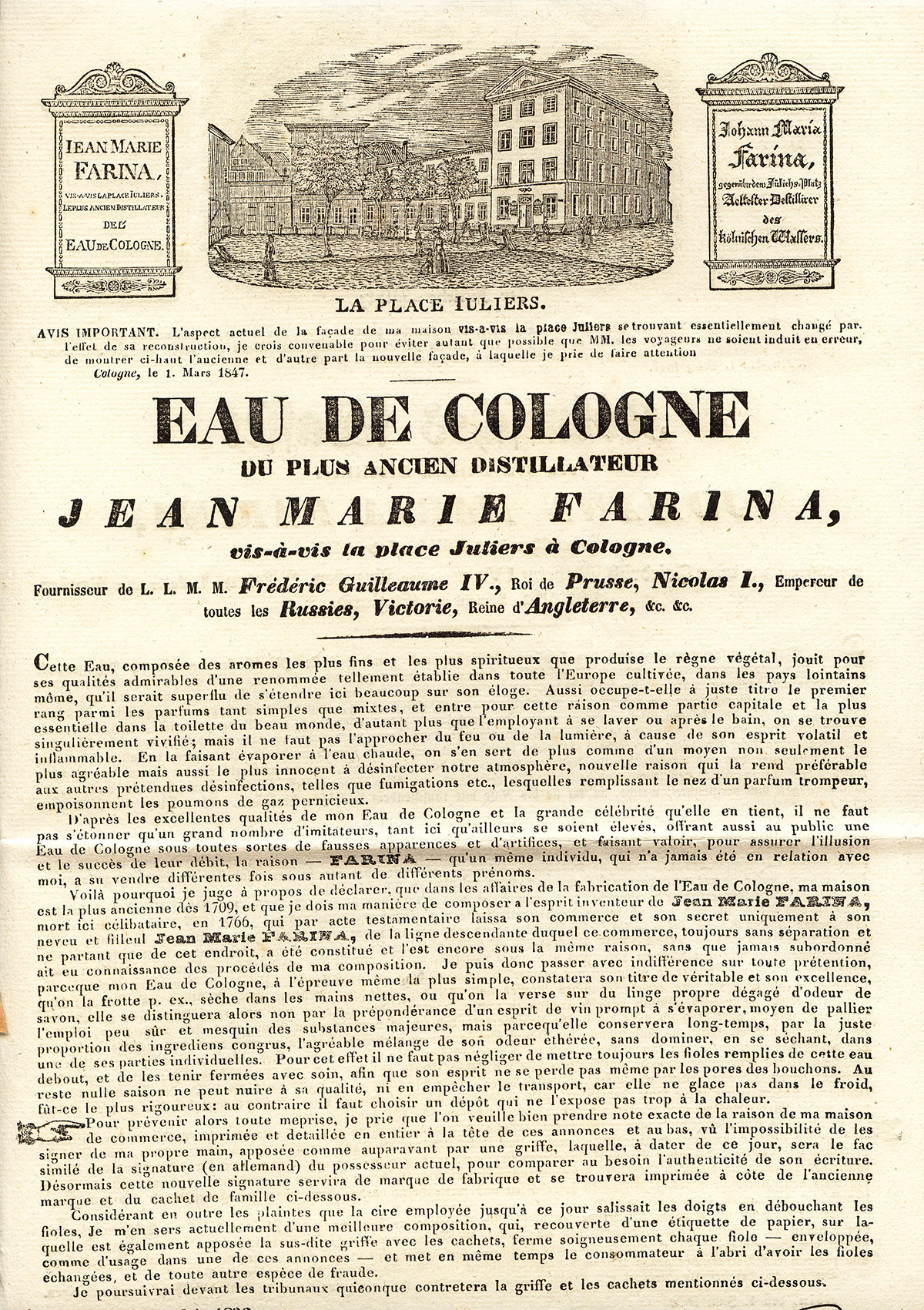
The “Acqua Mirabilis” as it was first named quickly met with success as it was understood that it was aptly named. When it was marketed in France under the term “Eau Admirable” by Jean-Marie Farina (1685 – 1766), the latter was not stingy with details announcing in an 18th century prospectus that “if we wanted to do the detail of all the pains with which this water is suitable for, it should be necessary to do the detail of all the infirmities to which the human body is subject.” This is a postulate that does not lack panache or temerity. And Farina went on to enumerate the various affections with which the Cologne overcome: apoplexy, migraine, eye pain, scurvy, gout, cuts and abrasions, paralysis, and that of man as well as animal! It also teaches the different ways in the 19th century to use this water: ingesting by pouring a few drops in wine or broth, apply it as a compress on damp cotton and especially rubbing the body regularly and especially when leaving the bath “in the time that the pores are open“.
The freshness it provided and the active principles that made it undoubtedly brought immediate relief to anyone who used it, but perhaps Farina was a little too confident in saying that his water, as delicious as it is, overcoming all the sickness. Moreover the Cologne was no longer in the category of drugs since the decree of 18th August 1810, which should not displease the Emperor who, according to Emmanuel de Las Cases (1766 – 1842), “does not believe in medicine or its remedies, of which he made no use […] He defends the thesis that it is better to allow nature to be done instead of encumbering it with remedies “. However, Cologne is the result of a pharmacological and medical reflection.
[thrive_leads id=’74591′]
Eau de Cologne: Medicine Before Cosmetics
In the Middle Ages and until the beginning of modern times, air quality (dry, wet, cold or hot) was considered the sole cause of disease. The scents of spice, herbs and flowers were intended to balance the body: each air quality matched assemblages of scents to prevent disease. Carried in pomander or mixed with vinegar, herbs, spices, barks, and flowers were considered remedies before being considered as cosmetics. The use of Cologne inherits this tradition from the rich therapeutic active principles that compose it. Formulated with natural essential oils, it is not far from our contemporary aromatherapy practices.
A History of Cologne
From Italian monastery to society Parisian boutiques, Cologne had a European fortune: its creator’s audacity plus vicissitudes of royal wars drew the conquest of this fragrance in all courts of Europe. Like its most fervent adept, the Emperor Napoleon I.
From Tuscany to Northern Europe.
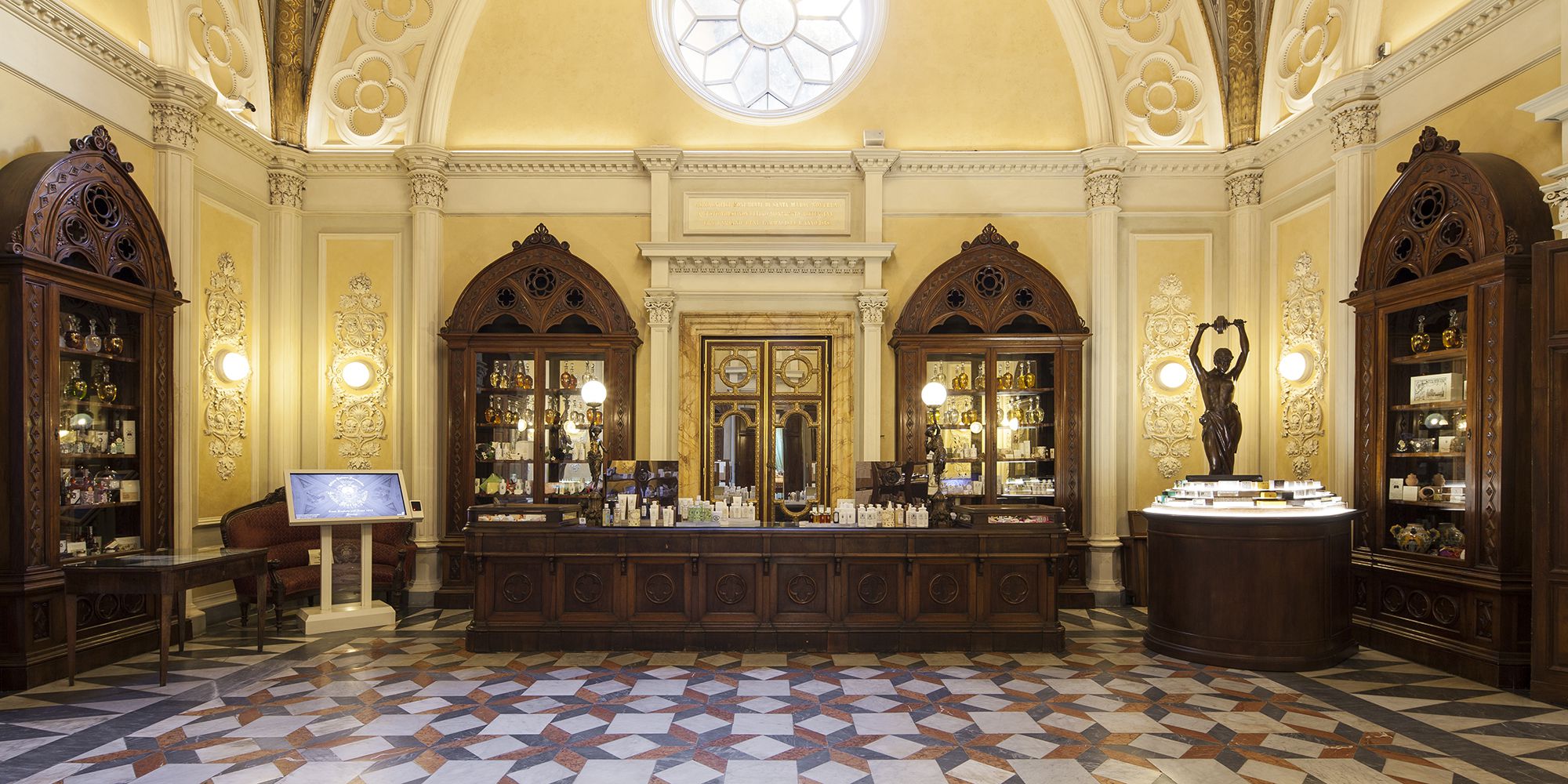
Bien naïf celui qui porterait sur l’eau de Cologne un regard complaisant ; comme souvent l’histoire est bien plus riche qu’il n’y paraît. Elle débute à Florence, dans le prospère XVIe siècle toscan où règne la maison Médicis. À deux pas de la basilique Santa Maria Novella, un couvent de Dominicains dispose d’un jardin de plantes médicinales à partir duquel les frères excellent dans l’élaboration d’essences, de potions, de pommades et de baumes.
Naïve, one who would take a complacent look at the cologne; as often History is much richer than it seems. It begins in Florence, in the prosperous 18th century Tuscan where reigns the Medici family. A stone’s throw from the Santa Maria Novella Basilica, a Dominican convent has a medicinal garden from which the friars excel in the elaboration of essences, potions, ointments and balms.
On the occasion of the departure for France Court of the very refined Catherine de Médicis (1519 – 1589), the Dominican monks elaborate especially for her a perfume thanks to an innovation which will initiate to the birth of Cologne. “Water of the Queen” with bergamot scent is not, as was the custom, made from vinegar but from alcohol. The intuition of holy men will pay off … but not for them! It is Giovanni Paolo Feminis (1660 – 1736) who will benefit from it. Born near Milan, he invented, from Water of the Queen, a hesperidic blend, which he foresaw the success. Our Italian moved to Cologne to commercialise this water he called “Acqua Mirabilis” and which concentrates all the mythical perfumes of an idealized Italy: bergamot, lemon, lavender and rosemary awaken the senses with their freshness and poetically evoke the Tuscan sun. Success is fast and his fortune is made. Rich but not eternal, Giovanni Paolo Feminis bequeaths the secret of his recipe to a member of his family so that his business remains.
[thrive_leads id=’74591′]
« Eau de Cologne » conquers Imperial France.
Let’s wait now for the Seven Years’ War (1756 – 1763) that brought French soldiers to Cologne. As military as he is, a French in a foreign land will forever remain a tourist. Thus the soldiers brought back bottles of Acqua Mirabilis in their kit. Cologne seduces Paris and it is all (the wealthier) France which hastens to get some. Jean-Marie Farina (1685 – 1766), nephew of Feminis, renames the Acqua Mirabilis in “Eau Admirable” and is proud to count Bonaparte among its most loyal customers. Countless colognes then flood the market and fierce competition triggers a lawsuit in Cologne at the beginning of the 20th century to determine the paternity of the Cologne. The Supreme Court of the Empire will decide, after tedious research, in favor of Giovanni Paolo Feminis.
In the end, it is no surprise that Napoleon found in this water a perfume very suitable for him. From the scents of his native Corsica to those of the nearby Tuscany, there is less distance than between Ajaccio and Paris. It will still have taken a voluntary expatriation and a war so that the meeting between the fragrance and the Emperor could take place. A proof if necessary that the essential always returns within our reach.

Napoleon and his use of the Cologne
Napoleon Bonaparte always paid a real attention to his personal hygiene, preferring the ablutions with water to the coquetry of dandies and aristocrats. Disturbed by the overpowering perfumes, the Emperor never perfumed himself but made a particularly abundant consumption of Cologne.
If the Emperor’s toilet was centered around his superb Athenian, it also consisted of daily baths whose hot water filled with steam, in the manner of the Arab baths, the rooms devolved for this purpose. Madame de Rémusat (1780 – 1821), lady attached to Josephine de Beauharnais (1763 – 1814), tells in her Memoirs that the Emperor, once washed, “made such floods [of Eau de Cologne] on himself that he used up to 60 rolls per month “(the “rolls” being the name given to the flasks of Farina’s Eau Admirable).
The French National Archives have thus found an invoice indicating that for the month of October 1808, 72 bottles of Eau de Cologne were ordered! Napoleon was indeed generously sprayed with Cologne after his ablutions and rubbed vigorously his whole body with a brush. He attributed to this habit – which he claimed to have brought back from the Orient (as perhaps his long hot baths) – his health and considered it to be most important. The story tells that on the eve of each decisive battle, he held at his desk one of the green flasks of Farina house. He attributed to the Cologne the same qualities usually given to coffee, and used to pour a few drops of Cologne on a handkerchief and then push it against his lips, then on his foreheads and temples.
[thrive_leads id=’74591′]
The Cruel Lack in St. Helena.
This fantastic consumption of Cologne collided, during the exile of the Emperor, with the notorious and nevertheless natural absence of perfumer on this lost island in the middle of the Atlantic. Emmanuel de Las Cases (1766 – 1842), private secretary of Bonaparte at St. Helena, never fails to remind readers of his Memoirs the constancy and courage of the Emperor in facing adversity. In the case of this Cologne affair, he testifies of a “real privation” that it was for Bonaparte to miss it. This deprivation must have been very great for Las Cases to report to us in these terms. Such a privation that Bonaparte could not tolerate it any more and begged the Mameluck Ali to make him a Cologne, thus giving birth to the only olfactory memory we had today of Napoleon.


