


18 Brumaire, Year VII: Napoleon Bonaparte orchestrates the slowest coup d’état in the history of France.
An emperor is not made alone, nor in a day. At the root of his rise are an iron will and hard work, luck and the talent of surrounding himself well.
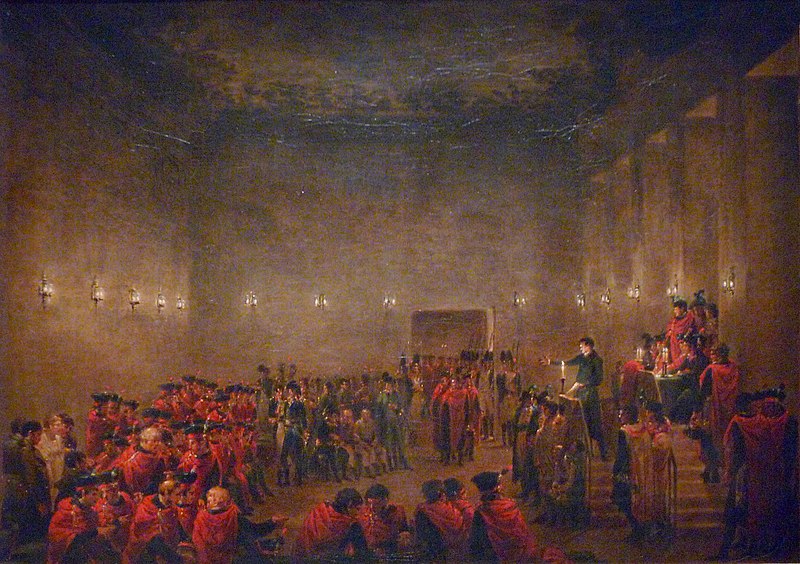
Our young Corsican was on the eve of his twenties when the Bastille was taken in July 1789. From this pivotal moment, everything happened in quick succession and his career truly began. In September 1793, he entered the siege of Toulon as a captain and left as a general in December. In 1796, he left for the Italian campaign. France was then a Republic, the first in its history. Marked by different periods, it opened with the National Convention – sadly famous for its episode of the Terror – from 1792 to 1795. A new constitution inaugurated a new chapter: the Directory, from 1795 to 1799. This regime was characterized by an executive power divided between five directors, heads of government and regularly renewed, between whom the ministers were distributed. The legislature is entrusted to two assemblies: the Council of Elders – ancestor of the Senate – and the Council of Five Hundred (comparable to our National Assembly). This political system, which aims to avoid tyranny, sits in the Luxembourg Palace in Paris.
It was precisely under the Directory that Napoleon began his historic rise, taking advantage of the difficult context in which the government was mired. The political instability and violence that accompanied the Revolution went hand in hand with an exhausting fight against the European coalitions directed against the French Republic as well as a fierce struggle, within the country itself, against the Chouans, royalist insurgents. The already deplorable economic situation did not improve. Because while the Directory set about laying the foundations of a solid financial system, cleaning up finances, making direct taxes fairer, indirect taxes multiplied and increased considerably. Public opinion mainly remembered the requisitions and forced loans, the permanent fighting and the no less so fumbling around. However, the foundations laid by the Directory would serve the following regime, the Consulate, with Napoleon Bonaparte at its head.
The Deserting General: Napoleon from Egypt to Paris
It was the recriminations against the Directory and serious military setbacks on the German, Italian and Swiss fronts that created the opportunity that Bonaparte knew how to seize. Considered the hero of the Italian campaign, the general who succeeded in everything had been in Egypt since May 1798. In July, the Battle of the Pyramids established the general’s prestige while Admiral Nelson sank his dreams of the Orient on 1st August in the harbor of Aboukir: the French fleet was annihilated. Other victories – as well as other defeats – still awaited him, until the victorious (land) Battle of Aboukir on 25 July 1799.

At the end of the latter, news of the French political situation reaches him; it is far from being cheerful. The Italian conquests that he has so highly staged in slick propaganda are lost and others seem on the verge of being so. Well aware that his flattering reputation as a victorious and peace-making general is still very much alive in France, carefully maintained by his brother Lucien (deputy to the Council of Five Hundred), General Bonaparte decides to return to France, without having received the order. In a word: he deserts, a choice in good taste, matching the landscape of North Africa.
Surrounded by the British, he nevertheless managed to slip away, taking with him the chief of staff Louis-Alexandre Berthier, General Joachim Murat, Brigadier General Auguste-Frédéric Viesse de Marmont, Major General Jean Lannes and the battalion commander and brigade commander Géraud-Christophe-Michel Duroc. He also did not forget the mathematician Gaspard Monge, the chemist Claude-Louis Berthollet and the great narrator of his adventures, the writer Dominique-Vivant Denon. This fine crew arrived in Fréjus on the evening of October 8; Bonaparte and Berthier left without delay for Paris.

Triumphant Return
In the meantime, the French military situation had been restored, but the Directory was not in odour of sanctity and all that was missing was the surprise arrival of the general to add fuel to the fire. Because all along the road that led him to Paris, the deserter was acclaimed and welcomed as a saviour (not to say as a king). While his superiors should, at the very least, have raised their voices, the news of his resounding victory at Aboukir reached Paris before him and made the headlines. Bonaparte, who had grown impatient during the crossing of the Mediterranean, worried about arriving too late and missing his chance, could not have entered the capital under better auspices. He now appeared to public opinion as the providential man.
It was the first time since the Revolution that a proper name was heard on everyone’s lips. Until then, people had said: the National Constituent Assembly had done such and such a thing, the people, the Convention; now, people spoke only of this man who was to put himself in everyone’s place, and make the human species anonymous.
Madame de Staël, Considérations sur les principaux événements de la Révolution française, tome 2, 1817, p. 8.
Preparation of the Coup
Certainly, Napoleon Bonaparte is acclaimed, but the clamour is not unanimous. What marks this triumphant return, however, are the votes he wins in all political camps. From the royalists to the Jacobins, he finds supporters who see in him what they want to see, because for the general only one thing is clear: he must absolutely keep his political intentions vague. If he now sees power coming within his reach, he is perfectly aware that the only way to bring down the Directory is to resort to a coup d’état that would be supported by public opinion. It is a question of flouting the political authority representing the people with the latter’s approval, of composing a “civil” coup d’état in a way. To do this, he must secure the necessary alliances without revealing them, and let each camp understand that he could be its ally. But most of the choices are quickly discarded. His former mentor Paul Barras, director of the Republic, is too associated with previous regimes, the Jacobins too unpopular. There remains Emmanuel-Joseph Sieyès (1748 – 1836), known as Abbé Sieyès, a strong personality whose skin reactions to contact with Bonaparte’s ego are easy to sense.
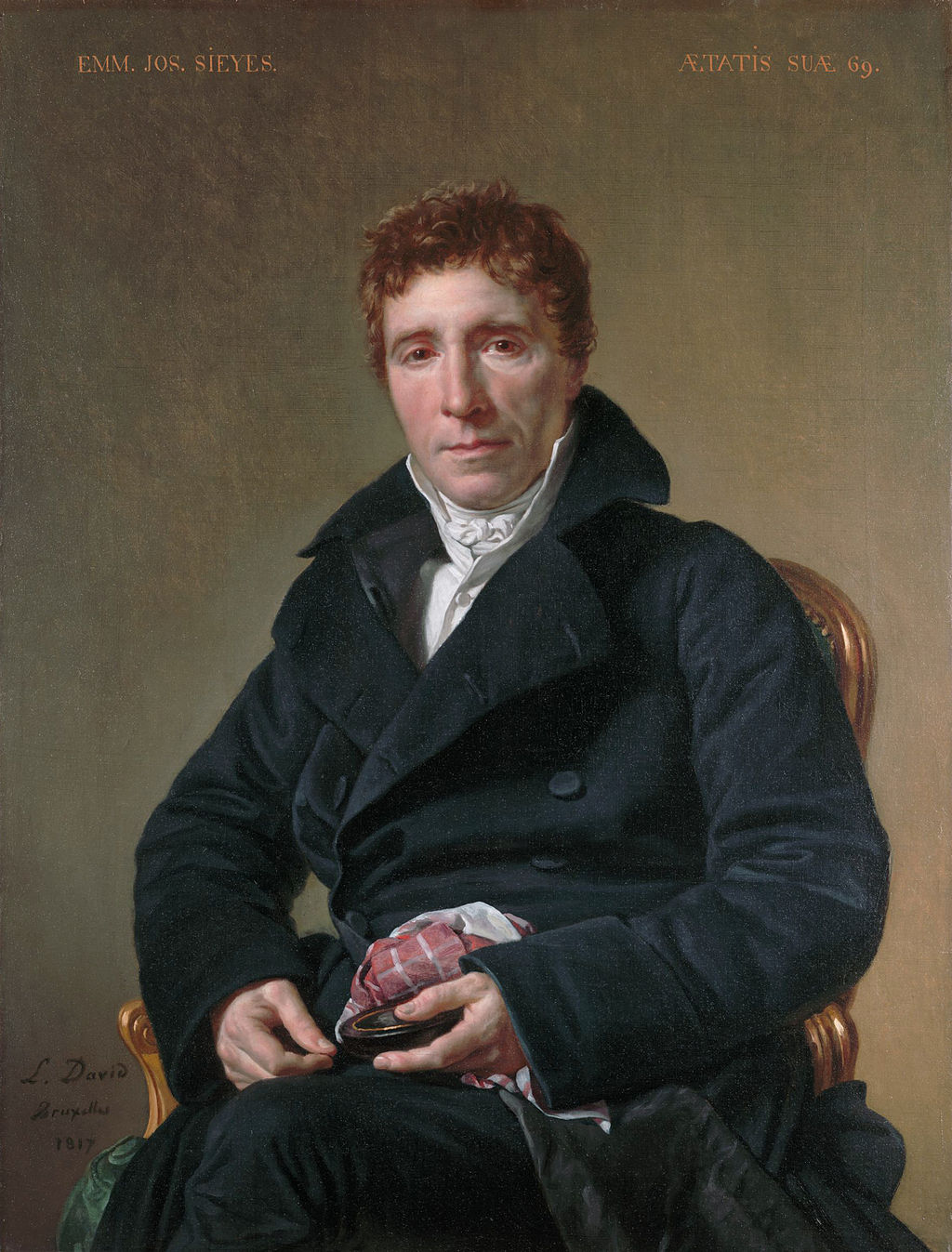
However, Sieyès and Lucien Bonaparte had drafted a constitution during the summer, which played in favour of the “civil” ambition of Bonaparte’s seizure of power. Although the two figures looked at each other with suspicion, they knew that they were mutually useful, and this was how the coup d’état of 18 Brumaire brought the two men to power.
18 Brumaire Year VII, another name for November 9, 1799
If we think about the 18th, we should also take into account the 19th Brumaire because this coup d’état took surprisingly long! It took two days to overthrow the Directory. The coup is perhaps the least appropriate term to describe this historical event, and the word “trap” would rather be preferable.
Two parts organized the dismissal of the regime in place. First, on the 18th, the movement of the representative assemblies of Paris to Saint-Cloud was organized. In order to justify this exceptional (and legal) arrangement, the organizers of the coup argued that a plot to assassinate the deputies had just been uncovered. To remove the representatives of the State from Paris, they were isolated so that their protection could be better ensured by the military troops led by Bonaparte. On the 19th, in Saint-Cloud, the deputies were heavily encouraged to vote for a change of regime, but some refused, guessing the real reason for the presence of the military. Bonaparte intervened with a speech so clumsy and awkward that even Louis Antoine Bourrienne (1769 – 1834), his friend and supporter, invited him to leave the room where the furious deputies were sitting.
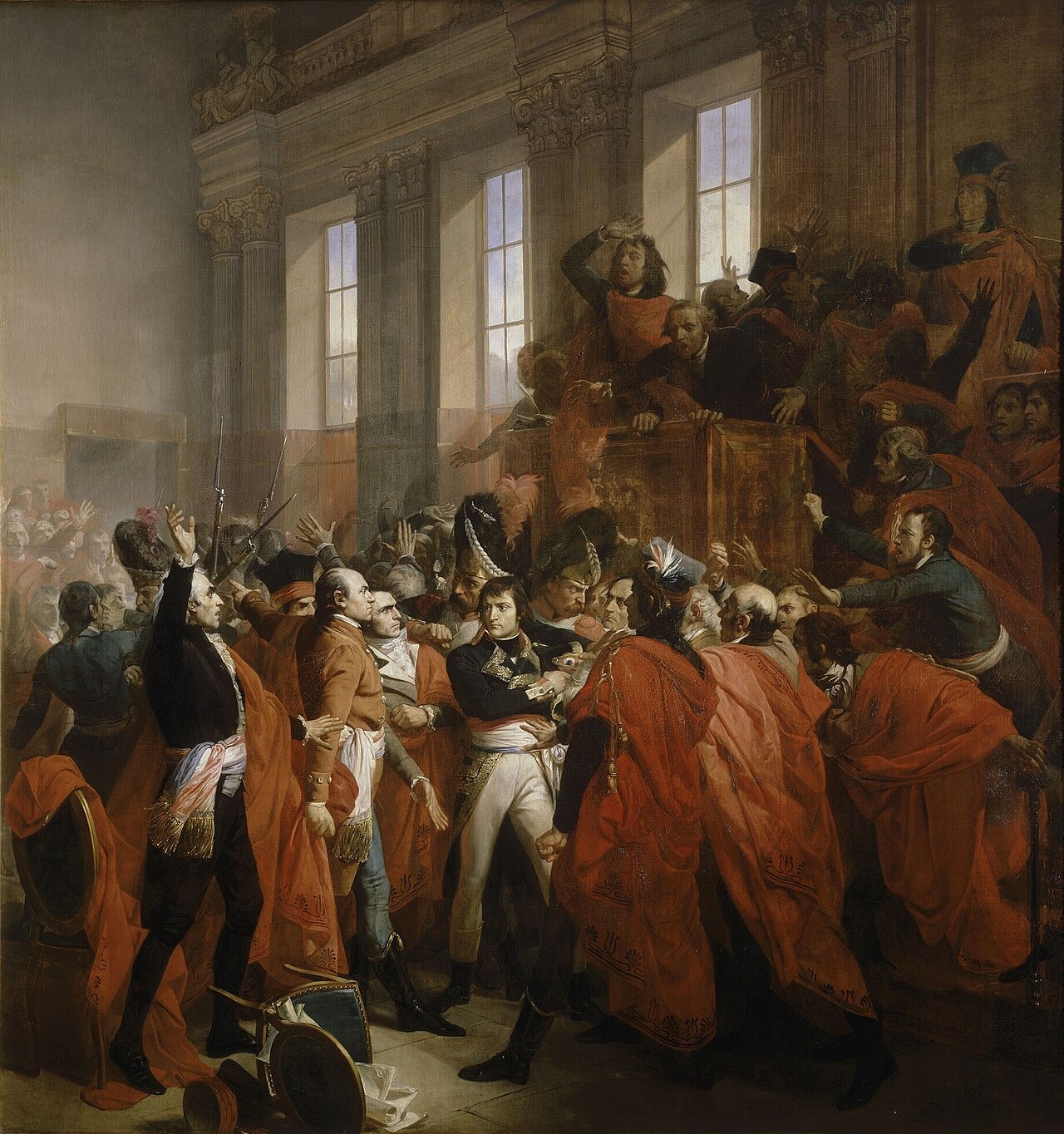
The heated negotiations thus stretched over two days and it was on the evening of the 19th that Lucien Bonaparte, at the head of the presidency of the Council of Five Hundred, declared the chamber legally constituted. The next day, the directorial power was entrusted to three provisional consuls: Bonaparte was the first and would remain so, then came Sieyès and Roger Ducos (1747 – 1816).
The Consulate was officially installed on January 1st, 1800 (11 Nivôse Year VIII). It was headed by the First Consul Napoleon Bonaparte, the Second Consul, Jean-Jacques-Régis de Cambacérès (1753 – 1824) and the Third Consul, Charles-François Lebrun (1739 – 1824). These were three different political sensibilities that aimed for a return to national cohesion and understanding. However, this new triumvirate was not to everyone’s taste, but no matter: for the years to come, it was now Napoleon who would have to be reckoned with.

[thrive_leads id=”74579″]


